
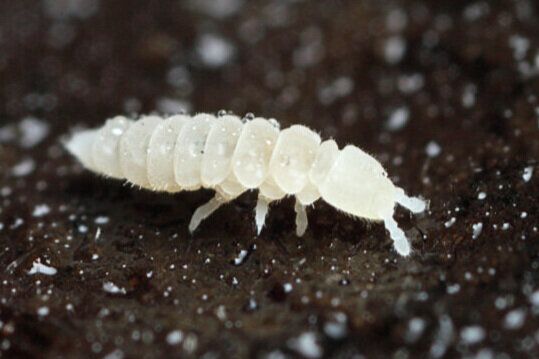
Springtails are tiny soil-dwelling arthropods that serve as a natural cleanup crew, consuming mold, fungi, and decaying matter in bioactive enclosures.
Out of Stock
Springtails are tiny soil-dwelling arthropods that serve as a natural cleanup crew, consuming mold, fungi, and decaying matter in bioactive enclosures.
Tiny white, gray, or colored specks often seen jumping when disturbed.
1–2 years
Fungi, mold, decaying organic matter, yeast.
Essential for bioactive enclosures; they are self-sustaining and low maintenance.
Easy – thrive in most humid terrarium conditions.
Colonies thrive in very small containers
Neutral to slightly acidic substrate
Not applicable (soil-dwelling microfauna).
70–80°F (21–27°C)
Up to 3 mm
Excellent with isopods, amphibians, reptiles, and invertebrates.
None – harmless to plants and animals.
Order Collembola
Various families (Entomobryidae, Isotomidae, etc.)
Worldwide distribution
Colony-forming, thrive in groups.
Yeast, rice, fish food flakes, or naturally occurring mold/fungi.
Breed prolifically in moist, humid substrates.
Breed continuously in moist, fungus-rich conditions.
Humidity: 70–95%, Temperature: 70–80°F (21–27°C).
Populations decline in dry conditions or without enough food.
Peaceful and beneficial microfauna.
Peaceful, substrate-dwelling microfauna; active jumpers when disturbed.
Springtails (Collembola) are one of the most important bioactive cleanup crew organisms. They are extremely small (1–3 mm), thrive in moist environments, and feed on mold and organic matter. Their presence helps prevent mold outbreaks in terrariums and maintains a balanced ecosystem.