
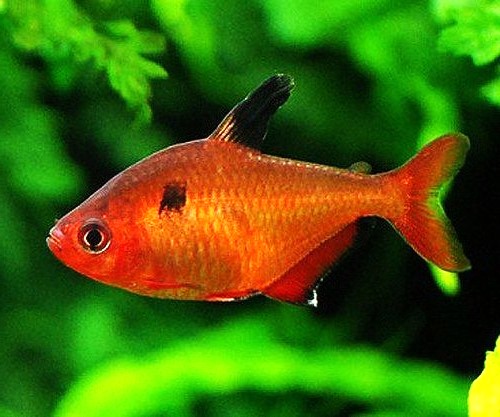
The Serpae Tetra (Hyphessobrycon eques) is a vibrant freshwater fish known for its deep red-orange body, black markings on the dorsal fin, and energetic schooling behavior. It is a popular choice for community tanks due to its striking color and dynamic movement.
Out of Stock
The Serpae Tetra (Hyphessobrycon eques) is a vibrant freshwater fish known for its deep red-orange body, black markings on the dorsal fin, and energetic schooling behavior. It is a popular choice for community tanks due to its striking color and dynamic movement.
Deep red-orange body with a shimmering metallic sheen. The dorsal fin is tipped with black, and the tail and anal fins often have black edging. Grows up to 1.8 inches (4.5 cm).
5–7 years with proper care
Omnivorous — feeds on high-quality flakes, micro-pellets, and small live or frozen foods such as bloodworms, brine shrimp, and daphnia.
The Serpae Tetra is a colorful and energetic addition to community aquariums, perfect for aquascapes and mid-level swimming areas. Keeping them in a proper school is essential to enjoy their best behavior and minimize stress on tank mates.
Moderate — requires stable water conditions and proper schooling numbers to prevent aggression.
20 gallons (for a school of 6–10+)
5.5 to 7.5
2–15 dGH
72–79°F (22–26°C)
1.8 inches (4.5 cm)
Compatible with other tetras, rasboras, danios, corydoras, peaceful livebearers, dwarf gouramis, and small shrimp/snails.
Avoid long-finned, slow-moving species such as angelfish and bettas, as Serpae Tetras may nip fins. Also avoid very small, delicate fish if aggression is observed.
Hyphessobrycon eques
Characidae
Rivers and streams of Brazil and other parts of South America
Schooling fish. Best kept in groups of 6 or more to reduce aggression and encourage natural schooling behavior.
Feed 2–3 times daily in small portions. Provide a balanced diet of flakes or micro-pellets, supplemented with live or frozen foods to maintain vibrant coloration and health.
Egg scatterer. Spawning occurs among fine-leaved plants or spawning mops. Adults must be removed post-spawning as they may eat the eggs.
Use a separate breeding tank with soft (1–5 dGH), slightly acidic water (pH 5.5–6.5), and dim lighting. Provide fine-leaved plants or spawning mops. Eggs hatch in 24–36 hours, and fry become free-swimming in 3–5 days. Feed fry with infusoria initially, then baby brine shrimp.
pH: 5.5–7.5, Temperature: 72–79°F (22–26°C), Hardness: 2–15 dGH, Ammonia/Nitrite: 0 ppm, Nitrate: <20 ppm.
Prone to ich, fin rot, and stress-related conditions if water quality declines or if schooling numbers are insufficient. Regular water maintenance is critical.
Semi-aggressive, especially if kept in small numbers; peaceful in proper schools
Semi-aggressive but social in groups. Thrives in schools of 6 or more, which minimizes fin-nipping and encourages natural behaviors. Active swimmers that enjoy mid- to upper-level tank spaces.
Native to the rivers and streams of South America, primarily in Brazil, the Serpae Tetra is admired for its rich red coloration and lively swimming. They thrive in planted aquariums with moderate lighting and gentle water flow. Best kept in schools of at least 6–10, these fish display coordinated schooling behavior. While generally peaceful, they may nip fins of slow-moving or long-finned tank mates if kept in insufficient numbers, making proper group size critical for minimizing aggression.