
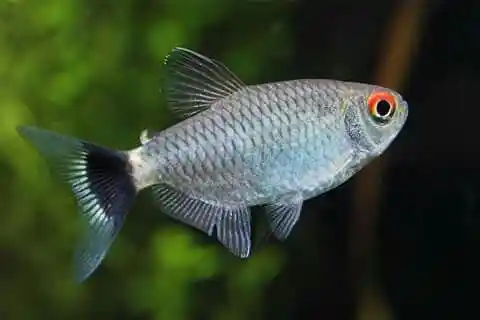
The Red Eye Tetra (Moenkhausia sanctaefilomenae) is a peaceful, small freshwater fish recognized by its striking red eyes and silver body with a faint black lateral line. It is an active schooling species, suitable for community aquariums.
In Stock: Yes
Quantity in Stock: Few left
The Red Eye Tetra (Moenkhausia sanctaefilomenae) is a peaceful, small freshwater fish recognized by its striking red eyes and silver body with a faint black lateral line. It is an active schooling species, suitable for community aquariums.
Slender, silver body with a faint black horizontal line from head to tail and distinctive red eyes. Adults grow up to 2 inches (5 cm). Males may show slightly more vivid red in the eyes.
3–5 years with proper care
Omnivorous — feeds on high-quality flakes, micro-pellets, and occasional live or frozen foods such as daphnia, brine shrimp, and bloodworms.
Red Eye Tetras are peaceful, visually striking, and lively fish. Their unique red eyes and schooling behavior make them an attractive addition to planted community aquariums.
Moderate — hardy if kept in proper schools and stable water conditions.
20 gallons (for a school of 6+)
6.0 to 7.0
2–12 dGH
75–79°F (24–26°C)
2 inches (5 cm)
Compatible with other peaceful tetras, rasboras, danios, corydoras, small livebearers, dwarf gouramis, and peaceful shrimp/snails.
Avoid aggressive or much larger fish that may bully or eat them. Long-finned fish may also be fin-nipped.
Moenkhausia sanctaefilomenae
Characidae
Paraguay and Paraná River Basins, South America
Schooling fish. Best kept in groups of 6 or more to encourage natural behavior and reduce stress.
Feed 2–3 times daily in small portions. Provide a varied diet of flakes, micro-pellets, and live/frozen foods for optimal health and vibrant eye coloration.
Egg scatterer. Spawns among fine-leaved plants or spawning mops. Adults should be removed post-spawning to avoid egg predation.
Requires a separate breeding tank with soft, slightly acidic water (pH 6.0–6.5, temperature 75–79°F / 24–26°C). Provide fine-leaved plants or spawning mops. Eggs hatch in 24–36 hours, fry become free-swimming in 4–5 days. Feed fry initially with infusoria, then gradually transition to baby brine shrimp.
pH: 6.0–7.0, Temperature: 75–79°F (24–26°C), Hardness: 2–12 dGH, Ammonia/Nitrite: 0 ppm, Nitrate: <20 ppm.
Prone to ich, fin rot, and stress-related illnesses if water quality declines or if not kept in adequate school sizes.
Peaceful, social schooling fish
Peaceful and schooling. Prefers mid-level areas in the tank. Exhibits active swimming behavior in groups. Schooling reduces stress and promotes natural activity.
Native to the Paraguay and Paraná river basins in South America, the Red Eye Tetra is admired for its vivid red eyes and peaceful demeanor. Best kept in schools of 6 or more, it exhibits synchronized schooling behavior, adding dynamic movement to community tanks. Prefers planted aquariums with gentle water flow and stable water parameters. Suitable for beginner and intermediate aquarists due to its hardy nature.