
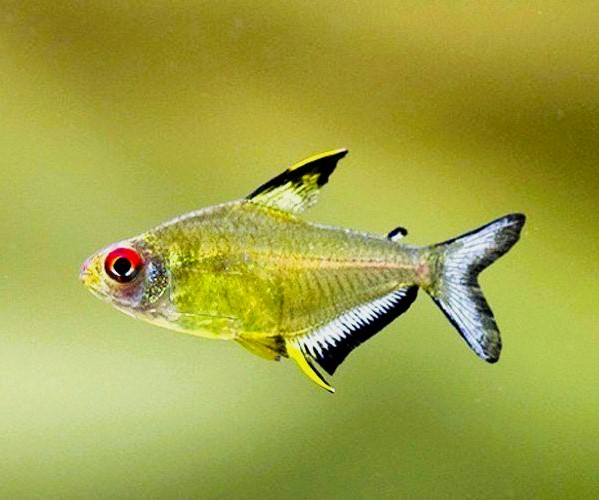
The Lemon Tetra (Hyphessobrycon pulchripinnis) is a small, peaceful freshwater fish known for its bright yellow body, iridescent green dorsal area, and transparent fins edged with red. It is a popular choice for community tanks due to its vibrant color and calm schooling behavior.
Out of Stock
The Lemon Tetra (Hyphessobrycon pulchripinnis) is a small, peaceful freshwater fish known for its bright yellow body, iridescent green dorsal area, and transparent fins edged with red. It is a popular choice for community tanks due to its vibrant color and calm schooling behavior.
Slender, bright yellow body with iridescent green dorsal area. Transparent fins edged with red, and a faint silver stripe along the lateral line. Adults grow up to 1.6 inches (4 cm).
3–5 years with proper care
Omnivorous — feeds on high-quality flakes, micro-pellets, and occasional live or frozen foods such as daphnia, brine shrimp, and bloodworms.
Lemon Tetras are a colorful, peaceful, and easy-to-care-for addition to any community aquarium. Their bright yellow hue and active schooling make them visually appealing and lively companions in planted tanks.
Easy — hardy fish, suitable for beginner aquarists.
15 gallons (for a school of 6–10+)
5.5 to 7.0
1–10 dGH
72–79°F (22–26°C)
1.6 inches (4 cm)
Compatible with other peaceful tetras, rasboras, danios, corydoras, small livebearers, dwarf gouramis, and small shrimp/snails.
Avoid large, aggressive, or fin-nipping species such as tiger barbs, large cichlids, or bettas.
Hyphessobrycon pulchripinnis
Characidae
Amazon Basin, Brazil
Highly social schooling fish. Best kept in groups of 6 or more to encourage natural swimming behavior.
Feed 2–3 small meals daily. Provide a balanced diet of flakes or micro-pellets, supplemented with live or frozen foods to enhance coloration and vitality.
Egg scatterer. Spawns in fine-leaved plants or spawning mops. Adults do not guard eggs and should be removed after spawning to prevent predation.
Requires a separate breeding tank with soft (1–5 dGH), slightly acidic water (pH 5.5–6.5), and dim lighting. Eggs hatch in 24–36 hours, and fry become free-swimming in about 4 days. Fry should be fed infusoria initially, then gradually transitioned to baby brine shrimp and finely crushed flakes.
pH: 5.5–7.0, Temperature: 72–79°F (22–26°C), Hardness: 1–10 dGH, Ammonia/Nitrite: 0 ppm, Nitrate: <20 ppm.
Prone to ich, fin rot, and stress-related illnesses if water quality deteriorates. Maintaining stable and clean water prevents most problems.
Peaceful, social schooling fish
Peaceful and social. Best kept in schools of 6 or more to exhibit natural schooling patterns and reduce stress. Active mid-level swimmers that enjoy moderate lighting.
Native to the Amazon Basin in Brazil, the Lemon Tetra is admired for its bright yellow body and sparkling coloration. They thrive in planted aquariums with soft, slightly acidic water and gentle water flow. Best kept in groups of 6–10 or more, they display harmonious schooling behavior and add a splash of color to the mid-level swimming areas of community tanks. Their peaceful nature makes them compatible with other small, non-aggressive species.