
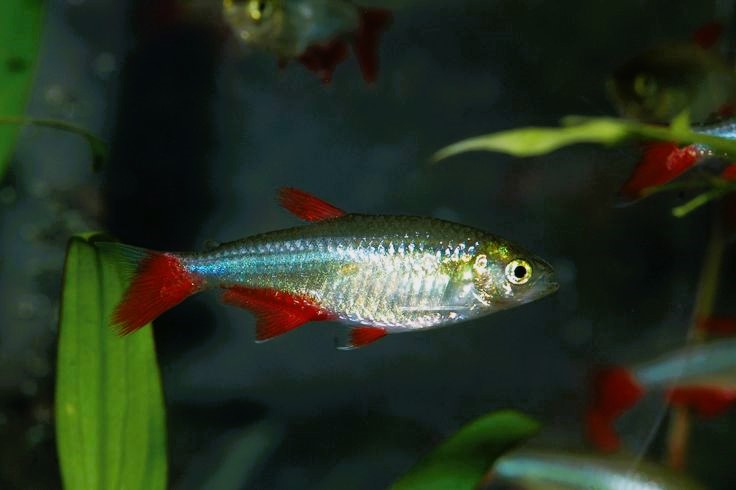
The Bloodfin Tetra (Aphyocharax anisitsi) is a hardy and active freshwater fish recognized by its shimmering silver body and striking bright red fins. It is an energetic schooling fish that thrives in community aquariums and is known for being very beginner-friendly.
Out of Stock
The Bloodfin Tetra (Aphyocharax anisitsi) is a hardy and active freshwater fish recognized by its shimmering silver body and striking bright red fins. It is an energetic schooling fish that thrives in community aquariums and is known for being very beginner-friendly.
Slender, silver body with metallic shine. Distinctive bright red coloration on the dorsal, anal, and tail fins, which contrasts beautifully with their silvery body. Grows up to 2 inches (5 cm).
5–8 years with proper care
Omnivorous — enjoys high-quality flakes, micro-pellets, as well as live and frozen foods such as brine shrimp, daphnia, and bloodworms.
The Bloodfin Tetra is an ideal choice for community aquariums, offering hardiness, active schooling behavior, and stunning coloration. A school of Bloodfin Tetras can bring constant movement and vibrancy to any tank.
Easy — very hardy and adaptable, making them suitable for beginners.
20 gallons (for a school of 6–10+)
6.0 to 8.0
3–20 dGH
70–82°F (21–28°C)
2 inches (5 cm)
Compatible with danios, rasboras, other tetras, corydoras, livebearers, small rainbowfish, dwarf gouramis, and peaceful shrimp/snails.
Avoid aggressive or much larger fish such as cichlids, or slow-moving long-finned species like bettas and angelfish, as they may nip fins.
Aphyocharax anisitsi
Characidae
Rivers and streams of Argentina and Paraguay, South America
Highly social schooling fish. Best kept in groups of 6 or more to reduce fin-nipping and bring out natural behaviors.
Feed 2–3 small meals per day. Offer a staple of flakes or micro-pellets, supplemented with live or frozen foods to maintain bright coloration and health.
Egg scatterer. Spawns among fine-leaved plants or spawning mops. Adults do not guard the eggs and should be removed after spawning.
Breeding requires a separate tank with soft, slightly acidic water (pH 6.0–7.0, temperature 75–80°F / 24–27°C). Eggs hatch within 24–36 hours, and fry become free-swimming in 3–4 days. Fry initially feed on infusoria or liquid fry food, later transitioning to baby brine shrimp.
pH: 6.0–8.0, Temperature: 70–82°F (21–28°C), Hardness: 3–20 dGH, Ammonia/Nitrite: 0 ppm, Nitrate: <20 ppm.
Generally hardy, but may suffer from ich, fin rot, or parasitic infections if water quality is poor. Stress from inadequate schooling numbers can lead to aggression.
Peaceful but active; can sometimes nip fins if not kept in a proper school.
Energetic and peaceful when in a proper school (6+). Without enough companions, they may display fin-nipping tendencies. Very active swimmers that prefer open space.
Bloodfin Tetras are native to the rivers and streams of South America, particularly in Argentina and Paraguay. Their silver body and bright red fins make them highly attractive and easy to recognize. These tetras are known for their lively swimming and adaptability, tolerating a wide range of water conditions. They are excellent for beginner aquarists due to their hardiness and peaceful temperament, especially when kept in groups of 6 or more. They also display well in planted aquariums with open swimming space.