
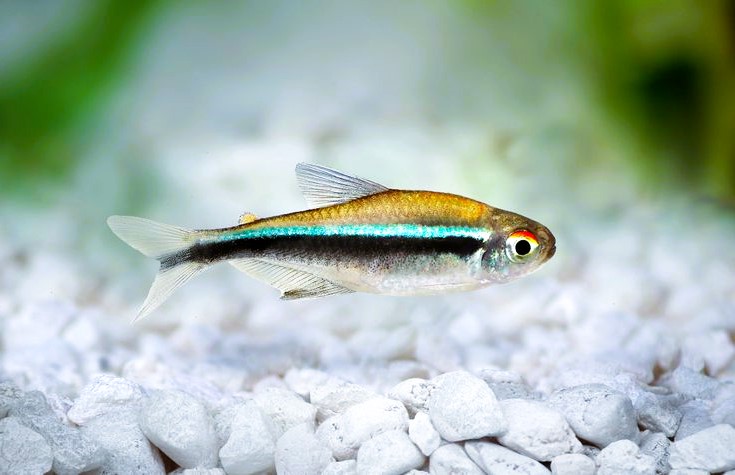
The Black Neon Tetra (Hyphessobrycon herbertaxelrodi) is a hardy and attractive freshwater schooling fish. Known for its striking horizontal black and white stripes and subtle greenish iridescence, it is a popular choice for community aquariums.
Out of Stock
The Black Neon Tetra (Hyphessobrycon herbertaxelrodi) is a hardy and attractive freshwater schooling fish. Known for its striking horizontal black and white stripes and subtle greenish iridescence, it is a popular choice for community aquariums.
Slender body with a bold black horizontal stripe across the length of the body, with a thin iridescent white line above it. The body has a greenish-golden sheen under the right lighting. Reaches up to 1.5 inches (4 cm).
3–5 years in captivity with proper care
Omnivorous — thrives on high-quality flakes, micro-pellets, live, and frozen foods such as brine shrimp, daphnia, and bloodworms.
The Black Neon Tetra is an excellent choice for community aquariums, combining beauty, resilience, and peaceful behavior. Their striking black-and-white stripes add elegance and contrast in planted setups. They are perfect for both beginner and advanced hobbyists.
Easy — highly adaptable and hardy compared to many other tetras.
15 gallons (for a school of 6–10)
5.5 to 7.5
1–10 dGH
72–82°F (22–28°C)
1.5 inches (4 cm)
Other peaceful fish such as neon tetras, cardinal tetras, rasboras, corydoras, small danios, dwarf gouramis, shrimp, and snails.
Avoid large, aggressive, or predatory species such as cichlids, bettas, or fin-nippers. Angelfish may prey on them if the size difference is too large.
Hyphessobrycon herbertaxelrodi
Characidae
Paraguay River basin, Brazil
Schooling fish, thrives in groups of 6 or more. Peaceful and highly active, perfect for planted aquariums.
Feed 2–3 times daily with flakes or pellets as a staple. Supplement with live or frozen foods like bloodworms, brine shrimp, or daphnia for optimal health and color.
Egg scatterer. Prefers soft, slightly acidic water with fine-leaved plants or spawning mops. Parents should be removed after spawning to prevent egg predation.
Breeding is possible in a separate breeding tank with soft (1–5 dGH), slightly acidic (pH 5.5–6.5) water. Females scatter eggs among fine plants. Eggs hatch within 24 hours, and fry are free-swimming in 3–4 days. They require infusoria or liquid fry food initially, followed by baby brine shrimp.
pH: 5.5–7.5, Temperature: 72–82°F (22–28°C), Hardness: 1–10 dGH, Ammonia/Nitrite: 0 ppm, Nitrate: <20 ppm.
Prone to ich, fin rot, and parasitic infections if water conditions are poor. Stress from small group sizes can weaken immunity.
Peaceful, active schooling fish
Peaceful, social, and highly active. They thrive in schools of at least 6–10, displaying synchronized swimming and playful schooling behavior.
Black Neon Tetras are native to streams and tributaries of the Paraguay River basin in Brazil. They are resilient, adaptable, and slightly larger than the common Neon Tetra. Their unique black horizontal stripe, offset by a glowing white line above it, makes them stand out in aquariums. They are ideal community fish, schooling peacefully with others of their kind and compatible species. They prefer aquariums with plants, driftwood, and dim lighting to bring out their subtle iridescence. Their hardy nature makes them a great choice for beginners while still being appreciated by experienced aquarists.