
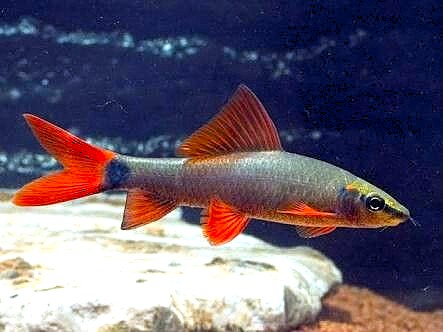
The Rainbow Shark (Epalzeorhynchos frenatum) is a peaceful yet semi-aggressive freshwater fish known for its dark gray to black body and striking red or orange fins. Not a true shark, it is an active swimmer that adds color and movement to community aquariums.
Out of Stock
The Rainbow Shark (Epalzeorhynchos frenatum) is a peaceful yet semi-aggressive freshwater fish known for its dark gray to black body and striking red or orange fins. Not a true shark, it is an active swimmer that adds color and movement to community aquariums.
Dark gray to black elongated body with vibrant red or orange dorsal, caudal, and anal fins. Laterally compressed body with small eyes and forked tail. Adults reach up to 6 inches. Agile, strong swimmer adapted for bottom and mid-level activity.
5–8 years with proper care
Omnivorous; feeds on high-quality flakes, pellets, and sinking foods. Supplement with live or frozen foods like bloodworms, brine shrimp, daphnia, and occasional blanched vegetables such as zucchini or spinach.
Rainbow Sharks are excellent for adding color, movement, and visual interest to community aquariums. They thrive in setups with adequate space, hiding spots, and peaceful tankmates.
Moderate – requires proper tank size, hiding spaces, and monitoring of territorial behavior.
55+ gallons
6.5 to 7.5
5–12 dGH
72–79°F (22–26°C)
6 inches
Peaceful community fish such as tetras, rasboras, gouramis, and barbs (non-aggressive). Avoid other Rainbow Sharks or similar-shaped fish in small tanks.
Other semi-aggressive or territorial fish of similar shape or size. Very small fish that may be harassed. Avoid delicate, slow-moving species.
Epalzeorhynchos frenatum
Cyprinidae
Southeast Asia – Thailand, Malaysia; rivers and streams with hiding spots and open swimming areas.
Semi-aggressive; best kept with peaceful fish of different body shapes and sizes. Territorial toward similar fish.
Feed 2 times daily with flakes, pellets, and sinking foods. Supplement occasionally with live or frozen foods and blanched vegetables for balanced nutrition and vibrant coloration.
Breeding in captivity is very rare. Eggs are scattered over substrate or plants with no parental care. Most Rainbow Sharks in the aquarium trade are captive-bred selectively.
pH: 6.5–7.5, Temperature: 72–79°F (22–26°C), Hardness: 5–12 dGH, Ammonia/Nitrite: 0 ppm, Nitrate: <20 ppm
Sensitive to poor water quality; prone to stress, ich, and bacterial infections. Maintain stable water parameters and regular tank maintenance.
Semi-aggressive and territorial, especially with similar-shaped fish. Best kept with peaceful species that occupy other areas of the tank. Establishes territories along the bottom and mid-levels. Active and fast-moving swimmer.
Native to Southeast Asia, particularly Thailand and Malaysia, Rainbow Sharks inhabit rivers and streams with sandy or rocky bottoms. Adults grow up to 6 inches and require a minimum of 55 gallons with hiding spots, caves, and open swimming areas. They are peaceful toward non-territorial tankmates but require space to establish territory. High-quality food, stable water parameters, and proper tank setup ensure health, activity, and vibrant fin coloration.