
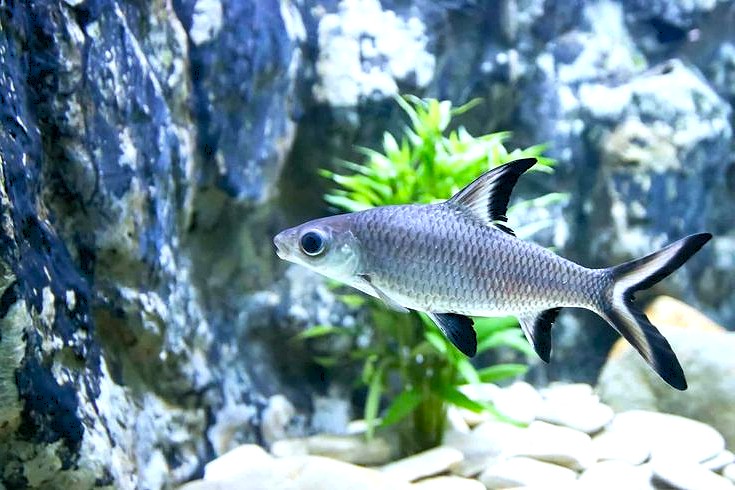
The Bala Shark (Balantiocheilos melanopterus) is a peaceful, active freshwater fish known for its sleek, silver body and striking black-edged fins. Despite its name, it is not a true shark. Popular in large community tanks, it is schooling and highly energetic, making it a captivating addition.
Out of Stock
The Bala Shark (Balantiocheilos melanopterus) is a peaceful, active freshwater fish known for its sleek, silver body and striking black-edged fins. Despite its name, it is not a true shark. Popular in large community tanks, it is schooling and highly energetic, making it a captivating addition.
Streamlined silver body with black-edged dorsal, caudal, and anal fins. Adult size can reach 12–14 inches. Bright silver sheen, torpedo-shaped body, small eyes, and forked caudal fin designed for fast swimming.
8–12 years with proper care
Omnivorous; feeds on high-quality flake or pellet food, supplemented with live or frozen foods such as brine shrimp, bloodworms, and daphnia. Also accepts vegetables like spinach and zucchini.
Bala Sharks are ideal for large community aquariums where their schooling behavior, active swimming, and peaceful temperament can shine. They require ample space and company of their own kind to thrive.
Moderate – requires large tank, schooling, and stable water parameters.
125+ gallons (for a school of 5+)
6.5 to 7.5
5–12 dGH
72–82°F (22–28°C)
12–14 inches
Peaceful medium to large community fish such as gouramis, barbs, rainbowfish, and large tetras. Avoid very small or aggressive fish.
Very small fish that may be mistaken for food. Aggressive species that could harass them. Avoid slow-moving, delicate fish that could be stressed by their activity.
Balantiocheilos melanopterus
Cyprinidae
Southeast Asia – Thailand, Malaysia, Indonesia; rivers and large streams with open swimming areas.
Highly social; best kept in schools of 5 or more. Peaceful with other large community fish.
Feed 2–3 times daily with high-quality flake, pellet, or sinking food. Supplement occasionally with live or frozen foods like brine shrimp, bloodworms, and daphnia, along with blanched vegetables.
Breeding in captivity is extremely rare and challenging. Eggs are scatterers with no parental care. Wild-caught specimens are more common in the aquarium trade than captive-bred individuals.
pH: 6.5–7.5, Temperature: 72–82°F (22–28°C), Hardness: 5–12 dGH, Ammonia/Nitrite: 0 ppm, Nitrate: <20 ppm
Sensitive to poor water quality; prone to stress, ich, and bacterial infections if not maintained properly. Stable water conditions are essential.
Peaceful, active, and schooling. Best kept in groups of at least 5 to prevent stress and promote natural behavior. Excellent mid- to upper-level swimmers. They are fast swimmers and require spacious aquariums with open swimming areas.
Native to Southeast Asia, including Thailand, Malaysia, and Indonesia, Bala Sharks inhabit rivers and large streams. Adults can grow up to 12–14 inches, requiring large tanks with plenty of swimming space. They are peaceful community fish but need to be kept in schools to reduce stress. Providing high-quality food, stable water conditions, and a spacious environment ensures health, vibrant coloration, and active behavior. Bala Sharks are excellent for adding movement and life to large community tanks.