
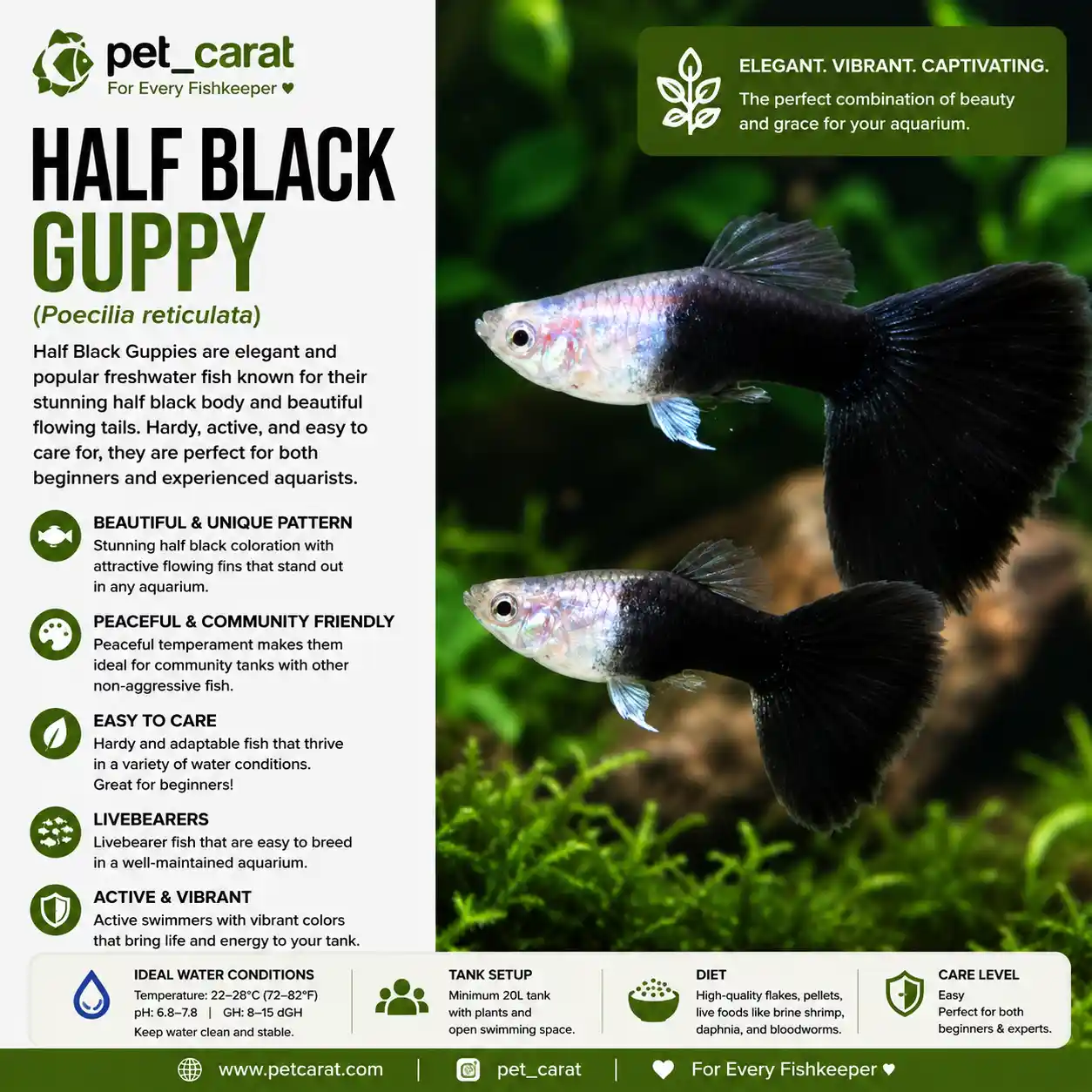
Half-Black Guppies are named for their distinctive half-black coloration on their bodies, creating a visually striking contrast with their tails. This unique coloration sets them apart.
In Stock: Yes
Quantity in Stock: Few left
Half-Black Guppies are named for their distinctive half-black coloration on their bodies, creating a visually striking contrast with their tails. This unique coloration sets them apart.
The Half-Black Guppy is named for its striking color pattern: the front half of the body is a bright, often metallic shade (such as gold, white, or pastel), while the back half from the mid-body to the tail is a deep, velvety black. This creates a bold contrast that is especially eye-catching under aquarium lighting. Males have longer, more ornate tails and brighter colors, while females are larger but less vividly colored.
1-3 years
Omnivorous
Half-Black Guppies are an excellent choice for both beginner and experienced aquarists. Their unique coloration, hardiness, and active swimming make them a centerpiece in community aquariums. They are also easy to breed, providing a rewarding experience for hobbyists looking to raise their own fish.
Beginner
10 gallons
6.8 – 7.8
Moderately hard to hard
22°C – 28°C (72°F – 82°F)
2.5 inches
Small peaceful fish like neon tetras, ember tetras, rasboras, mollies, platys, Corydoras catfish, and ornamental snails
Poecilia reticulata
Poeciliidae
Originally from South America, selectively bred worldwide
Peaceful, social, thrives in groups
Their diet should be varied to maintain health and vibrant coloration. Offer high-quality flake or micro-pellet food daily, with live or frozen protein-rich foods such as brine shrimp, bloodworms, or mosquito larvae given 2–3 times per week. Supplement with blanched spinach, zucchini, or peas for fiber and vitamins, which help prevent digestive issues.
Livebearer – females give birth to fully formed fry without parental care
Breeding Half-Black Guppies is straightforward due to their prolific livebearing nature. Gestation lasts about 21–30 days, with each brood producing 20–60 fry. Females can store sperm from previous matings, allowing them to give birth multiple times without additional contact with a male. Fry are relatively large and able to eat powdered fry food, crushed flakes, or freshly hatched baby brine shrimp immediately after birth. To prevent predation, use dense plants like Java moss or a separate breeding box.
Maintain stable water conditions with a pH of 6.8–7.8 and moderate to high hardness. Keep the temperature between 72°F and 82°F (22°C–28°C). Use a gentle filtration system that provides good biological filtration without creating strong currents. Perform 25–30% water changes weekly to control nitrate buildup and promote optimal health.
Common health concerns include fin rot, ich, and bacterial infections when water quality declines. Due to their long fins, Half-Black Guppies may be vulnerable to fin-nipping species. Overfeeding or sudden dietary changes can cause bloating or swim bladder problems.
Peaceful
Half-Black Guppies are peaceful, active, and display constant movement throughout the aquarium. They are curious fish that interact with their surroundings and other guppies. Males frequently perform display dances to attract females, fanning their tails to show off their unique two-tone coloration. They thrive in planted aquariums where they can weave between leaves and open spaces.
The Half-Black Guppy (Poecilia reticulata) is a selectively bred variety developed for its bold two-tone coloration. Wild guppies originate from the streams and rivers of South America, but this variety has been refined by breeders to produce a sharp division between the colored front half and jet-black rear half. They are peaceful, adaptable, and thrive in well-planted aquariums with stable water parameters. As livebearers, they reproduce easily, and their fry can grow quickly with proper care. Half-Black Guppies are especially popular in aquascaped tanks, where their contrasting colors stand out against green plants and natural décor. With a lifespan of 2–3 years, they provide both beauty and activity, making them a long-time favorite in the aquarium hobby.