
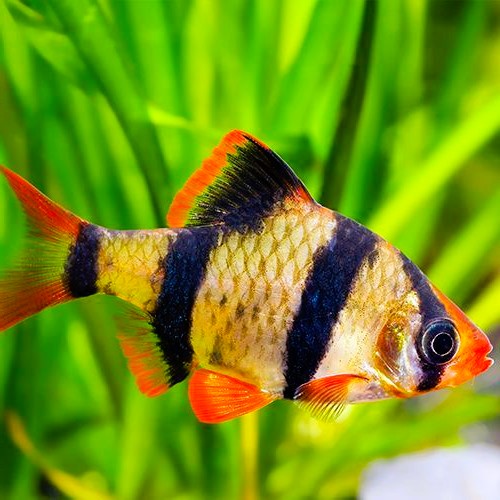
The Tiger Barb (Puntigrus tetrazona) is a small, active freshwater fish known for its striking orange body with black vertical stripes. It is a schooling fish that adds movement and color to community aquariums.
In Stock: Yes
Quantity in Stock: Few left
The Tiger Barb (Puntigrus tetrazona) is a small, active freshwater fish known for its striking orange body with black vertical stripes. It is a schooling fish that adds movement and color to community aquariums.
Bright orange body with 4–5 black vertical stripes, slightly forked tail. Adults grow up to 3 inches (7.5 cm). Males often show more intense coloration than females.
5–7 years with proper care
Omnivorous — feeds on high-quality flakes, micro-pellets, and occasional live or frozen foods such as bloodworms, daphnia, and brine shrimp.
Tiger Barbs are energetic, visually striking, and interactive. Proper schooling and tank setup are essential for minimizing aggression, making them a rewarding species for community aquariums.
Moderate — hardy but requires proper school size to manage aggression.
30 gallons (for a school of 6+)
6.0 to 7.5
5–15 dGH
74–79°F (23–26°C)
3 inches (7.5 cm)
Suitable with other active, similarly sized fish. Avoid long-finned or slow-moving species.
Avoid long-finned or slow-moving fish like Angelfish, Guppies, or Betta, as Tiger Barbs may nip fins.
Puntigrus tetrazona
Cyprinidae
Southeast Asia – Indonesia
Schooling fish. Best kept in groups of 6 or more to reduce nipping and promote natural behavior.
Feed 2–3 times daily in small portions. Offer a varied diet including flakes, pellets, and live/frozen foods to maintain vibrant coloration and health.
Egg scatterer. Spawns over fine-leaved plants or spawning mops. Adults do not guard eggs and may eat them, so separate breeding tank is recommended.
Set up a separate breeding tank with soft, slightly acidic water (pH 6.0–6.5, temperature 78–82°F / 25–28°C). Provide spawning mops or fine-leaved plants. Eggs hatch in 24 hours, fry become free-swimming in 3–4 days. Feed fry infusoria or baby brine shrimp.
pH: 6.0–7.5, Temperature: 74–79°F (23–26°C), Hardness: 5–15 dGH, Ammonia/Nitrite: 0 ppm, Nitrate: <20 ppm.
Prone to ich, fin rot, and stress if water quality is poor or if kept in small groups.
Semi-aggressive and active; schooling behavior helps reduce aggression.
Active, schooling, and sometimes nippy. Prefers mid-level swimming. Aggression decreases in larger groups.
Native to Southeast Asia, primarily Indonesia, the Tiger Barb is a hardy and lively species. Best kept in schools of 6 or more to mitigate aggressive tendencies, it thrives in community aquariums with other active fish. Requires a well-planted tank with open swimming spaces and moderate water flow. The Tiger Barb's bold coloration and energetic swimming make it a visually captivating addition to home aquariums.