
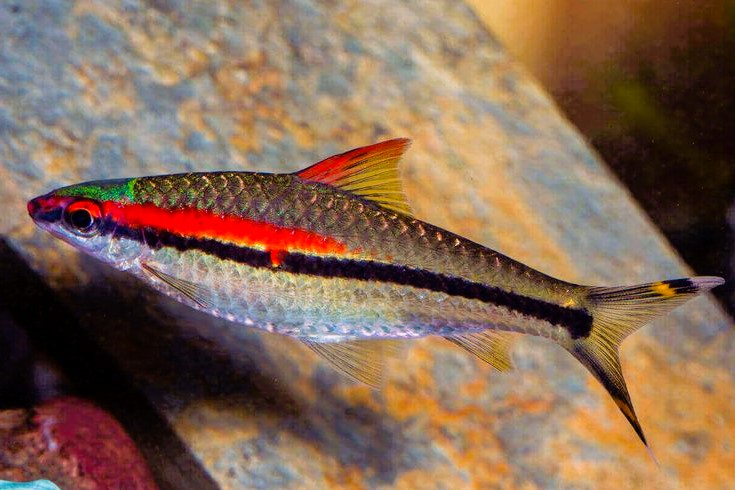
The Denison Barb (Sahyadria denisonii), also known as the Red-Line Torpedo Barb, is a striking freshwater fish with a torpedo-shaped body, a bright red horizontal stripe from the snout to the tail, and a golden-yellow dorsal fin. It is active, schooling, and highly sought after for its vibrant appearance.
Out of Stock
The Denison Barb (Sahyadria denisonii), also known as the Red-Line Torpedo Barb, is a striking freshwater fish with a torpedo-shaped body, a bright red horizontal stripe from the snout to the tail, and a golden-yellow dorsal fin. It is active, schooling, and highly sought after for its vibrant appearance.
Slender, torpedo-shaped body with a prominent red horizontal stripe from the snout to the tail. Golden-yellow dorsal fin with a black tip. Body shows silvery scales with hints of green. Adults reach up to 4–5 inches (10–12.5 cm).
6–8 years with proper care
Omnivorous — feeds on high-quality flakes, pellets, and occasional live or frozen foods such as bloodworms, brine shrimp, and daphnia.
Denison Barbs are stunning, active schooling fish that enhance the visual appeal of community tanks. Maintaining proper water quality, group size, and habitat setup is key to their health and vibrant coloration.
Intermediate — requires stable water parameters, clean water, and adequate schooling.
40 gallons (for a school of 6+)
6.5 to 7.5
5–12 dGH
72–78°F (22–26°C)
4–5 inches (10–12.5 cm)
Compatible with other peaceful, active, similarly sized fish such as tetras, danios, and other barbs.
Avoid slow-moving or long-finned species such as Angelfish or Bettas that may be stressed by active behavior.
Sahyadria denisonii
Cyprinidae
Western Ghats, India
Schooling fish. Best kept in groups of 6 or more to promote natural behavior and reduce stress.
Feed 2–3 times daily in small portions. Offer a varied diet including flakes, pellets, and occasional live/frozen foods to maintain color and health.
Egg scatterer. Breeding in captivity is challenging; eggs are scattered among plants and not guarded by adults. Requires specialized conditions.
Captive breeding is rare and requires specialized conditions including strong water flow, slightly acidic to neutral water (pH 6.5–7.0), and soft water. Eggs scatter among plants; fry require microscopic foods like infusoria initially.
pH: 6.5–7.5, Temperature: 72–78°F (22–26°C), Hardness: 5–12 dGH, Ammonia/Nitrite: 0 ppm, Nitrate: <20 ppm.
Prone to stress-related issues, ich, and fin rot if water quality is poor or schooling numbers are insufficient.
Peaceful yet active; best kept in schools to encourage natural behavior and reduce stress.
Active, schooling, and social. Prefers mid-level swimming zones. Peaceful with other similarly sized, non-aggressive fish.
Native to fast-flowing rivers of the Western Ghats, India, the Denison Barb is a visually stunning and active schooling fish. It thrives in planted aquariums with open swimming spaces and moderate water flow. This species is sensitive to water quality, so stable and clean conditions are essential. Ideal for intermediate to advanced aquarists due to its specific care requirements.