
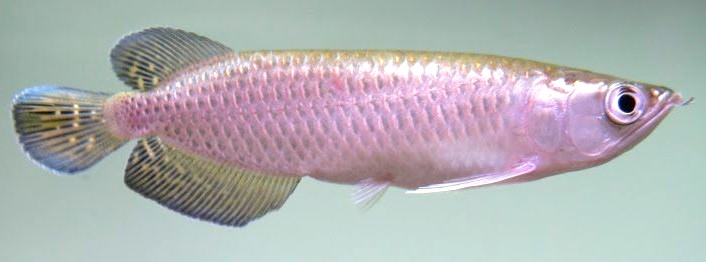
A unique Arowana species native to Northern Australia, known for its pearly sheen and graceful swimming style.
Out of Stock
A unique Arowana species native to Northern Australia, known for its pearly sheen and graceful swimming style.
Sleek, elongated body with pearl-like scales that shimmer under aquarium lighting. Fins are long, with subtle golden or bronze tones.
10–15 years
Carnivorous; eats insects, small fish, shrimp, and worms. Will accept high-protein pellets with training.
Australian Pearl Arowana is a rare and captivating fish, valued for its beauty and uniqueness. While slightly more forgiving than Asian Arowana, it is still best suited for advanced aquarists.
Advanced; needs at least a 200-gallon aquarium, strong filtration, and careful attention to diet and water quality.
200 gallons
6.5 to 7.5
3–10 dGH
75–82°F (24–28°C)
24 inches (60 cm)
Large catfish, bichirs, and peaceful large fish in oversized aquariums.
Small fish, fin-nippers, and overly aggressive cichlids.
Scleropages jardinii
Osteoglossidae
Northern Australia, found in freshwater rivers and billabongs.
Solitary or in very limited company with robust, non-aggressive large fish.
Feed daily with a mix of live, frozen, and pellet-based meaty foods. Avoid overfeeding.
Mouthbrooder; males carry fertilized eggs in their mouths until fry are ready to swim freely.
Females produce 30–60 eggs. The male mouthbroods for 5–7 weeks until fry are released. Fry should be fed with brine shrimp and gradually introduced to larger foods.
pH: 6.5–7.5, Temperature: 75–82°F (24–28°C), Hardness: 3–10 dGH
Gill curl, drop eye, and parasitic infections if water conditions are not ideal.
Semi-aggressive and territorial; less aggressive than the Asian Arowana but still best kept alone or with very large tank mates.
Graceful swimmer but territorial. Can coexist with select large fish in spacious tanks.
The Australian Pearl Arowana, also called the Jardini Arowana, is admired for its shimmering pearly scales and elegant movements. Compared to its Asian cousin, it is slightly less aggressive but still requires a very large tank and expert care. They thrive in warm, clean water and must be fed a protein-rich diet. Breeding is difficult in captivity and requires specialized environments.